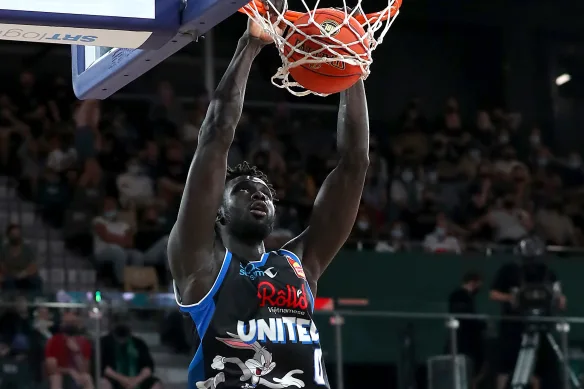
Jo Lual-Acuil Jr
October 27, 2025



NICKNAME/S: GQ, GQ Smooth, Quey, Puppy
BIO: One of Australia’s most experienced and successful players, Andersen has won 12 league championships (9 European national domestic league championships and 3 EuroLeague championships) abroad and has played in Italy, Russia, Spain, Turkey and France. He has won 14 championships around the world in addition to 103 NBA games for three NBA clubs.
David Emil Andersen grew up in Frankston where he was introduced to basketball at a early age. His mother Mary played netball and basketball and thought it would be a good sport to get all her children involved in. At the age of five, David was playing in the school basketball team at Frankston East Primary with one of his brothers, Stuart. Mary coached the team and because there was only one team at the school, David always played a year above his age. Also, while at primary school David tried his hand at many different sports before deciding to focus on basketball. He had found a game he loved to play, a game where his above average height would be a advantage.
The local representative basketball club was the Frankston Blues. David joined the club when he was 11 years old and in his first year at the club, the under 12 team David played in, won the championship. This was to be one of the first of many successes that David would experience with a team in basketball. David played with the Frankston Blues Junior Program until he was 15 years old and then joined the Frankston Blues Men’s Team.
He played in the 1995 CBA Grand Final, a game that was televised on the ABC TV.
Standing at 197 cm tall, David caught the eye of Gordie McLeod, the head basketball coach at the Australian Institute of Sport.
As a Victorian State player in the Under 16 Australian Junior Championships, David was again spotted by the AIS scouts and was selected to join the Australian Institute of Sport Basketball Development Program in 1996. He spent three years there and played for the program’s SEABL team between 1996-1998). Whilst in Canberra and in conjunction with the AIS, he attended Lake Ginninderra Secondary College.
At the conclusion of his time at the Australian Institute of Sport, not only had grown 15 centimetres in height but also signed his first professional contract to play with the South East Melbourne Magic, allowing him to return home to Melbourne. Before the season began however the club merged with crosstown rival North Melbourne Giants to become the Victoria Titans and his contract voided. At 17 Andersen signed a two-year deal with the Wollongong Hawks.
FAMILY: Andersen is the second youngest of five children. His parents, Mary and Danny raised their four sons and one daughter in Frankston, Victoria.
David Andersen made his NBL debut with the Wollongong Hawks at 18 years of age. He scored nine points in his first game.
Coinciding with the NBL’s move to summer, the Hawks shifted base to the Wollongong Entertainment Centre and swapped their Illawarra prefix to Wollongong. Coming off a 14 win season that saw the Hawks reach the postseason, the Hawks were able to retain almost their entire and add CJ Bruton (via Brisbane) who immediately became Wollongong’s starting point guard and primary offensive weapon. With the addition of Bruton, there was no need for import guard Elliot Hatcher and they replaced him with Theron Wilson. Also, talented big man David Andersen was recruited from the AIS to replace the outgoing Matt Zauner.
Bruton (20.8 points, 4.3 rebounds, and 3.5 assists) would be given the ‘green light’ as he boosted his scoring from 15.4 points to 20.8 points per game in 46 minutes per game. Clayton Ritter (17.6 points, 6.3 rebounds, and 1.4 assists 1.1 steals) and Mat Campbell (15.0 points, 3.6 rebounds, and 2.5 assists) also finished among the team’s high scorers.
The Hawks finished the season winning two more games than the year prior, improving upon their previous record for the third year in a row and finishing in third place (16-10).
A disappointing postseason first saw the Hawks lose to the Victoria Titans in two straight games during the Qualifying Finals, but thanks to the league’s of the ‘lucky loser’ rule, which allowed the highest placed loser from the Qualifying Finals to proceed to the next round. There, a matchup with Adelaide saw Illawarra eliminated in two straight games, ending their season for good this time.
Andersen appeared in 25 games and averaged 6.2 points, 4 rebounds, and 0.6 assists. David played one year of his two year contract with the Hawks before signing with European basketball club Virtus Bologna in Italy.
MELBOURNE UNITED
2016/17
After finishing first with an 18-10 record in 2015/16 before being swept 2-0 by New Zealand in the semifinals, Melbourne entered Dean Demopoulos’ second season with another reshaped roster. Stephen Holt (to Zaragoza), Hakim Warrick (to Olympiacos) and Daniel Kickert (to Brisbane) departed, while Cedric Jackson (via New Zealand), Ramone Moore (via Pieno Zvaigzdes), Devin Williams (via West Virginia), Tai Wesley (via New Zealand) and David Andersen (via ASVEL) joined United. Andersen returned to the NBL for the first time since playing with Wollongong in 1998/99, signing a two-year deal on July 16 after helping ASVEL win the French championship and was named Melbourne captain. “It’s great to be home — I’m excited about the club and the challenge of bringing the championship back to Melbourne,” Andersen said.
Melbourne opened the season against New Zealand at Vector Arena on October 7, where Andersen (9 points, 4 rebounds, and 5 assists) started as captain in United’s 76-71 loss. Wesley (15 points) and Jackson (14 points, 13 rebounds, and 6 assists) led Melbourne, while Thomas Abercrombie (14 points and 5 rebounds) was New Zealand’s leading scorer.
Andersen (9.8 points and 4.4 rebounds across 19 games) started his first 14 appearances before a knee injury removed him from the lineup for nine consecutive games. He returned late in January and came from the bench in each of Melbourne’s final five games.
Andersen’s best and highest-scoring game came against Illawarra on November 6, where Andersen (23 points, 8 rebounds, 2 assists, 1 steal, and 1 block) made 10-of-17 field goals as an injury-hit Melbourne played without Goulding and Blanchfield. Williams (13 points and 7 rebounds) and Tomlinson (7 points, 7 rebounds, and 3 assists) provided support, while Nicholas Kay (15 points and 5 rebounds) led Illawarra as the Hawks defeated United 82-73 and dropped Melbourne to 3-6.
On December 4, Andersen (10 points, 7 rebounds, 5 assists, 1 steal, and 2 blocks) helped Melbourne defeat New Zealand 98-74 in front of 10,300 fans at Hisense Arena. Ware (26 points and 5 assists) and Goulding (14 points) led United, while Kirk Penney (19 points) was New Zealand’s leading scorer as Melbourne recorded its third win from four games following Ware’s arrival.
Five days later against Perth, Andersen played only 2:23 before leaving the game with a knee injury. Melbourne announced on December 12 that he would be sidelined for approximately six weeks, and he missed the next nine games while recovering. His absence overlapped with a knee injury to Williams, leaving United short of frontcourt players and resulting in Josh Boone being brought in as a temporary injury replacement.
Andersen returned against Perth on January 28 after almost seven weeks out, playing 10 minutes from the bench before his minutes increased over the final weeks. His strongest game after returning came against Sydney on February 4, where Andersen (21 points, 3 rebounds, and 2 assists) made 8-of-11 field goals and all four of his three-point attempts as Melbourne defeated the Kings 89-76 at Qudos Bank Arena. Ware (18 points and 5 assists) and Boone (12 points, 14 rebounds, 1 steal, and 3 blocks) provided support, while Brad Newley (19 points and 3 assists) led Sydney. The win kept United’s finals hopes alive and improved Melbourne to 12-13.
Melbourne’s poor start had already resulted in Jackson (8.7 points, 4.6 rebounds, 5.1 assists, and 1.3 steals across 9 games) being released on November 9 with United sitting 3-6. Another loss left Melbourne 3-7 before Casper Ware (via Washington) arrived as his replacement, with Ware (22.1 points, 4.5 assists, and 1.3 steals across 18 games) playing every remaining game and helping United go 10-8 over its final 18 games. Ware was later selected to the All-NBL First Team.
Williams (3.2 points and 3.9 rebounds across 16 games) missed five weeks with his knee injury and Boone (via Pinar Karsiyaka) arrived on December 23 as a temporary injury replacement while both Williams and Andersen were unavailable. Boone (10.1 points and 9.3 rebounds across 12 games) quickly became one of Melbourne’s most effective players and, when Williams returned to full fitness, United chose to retain Boone for the remainder of the season and released Williams on January 31 under the import rules. Moore (10 points across 20 games) then suffered a season-ending calf injury and Lasan Kromah (via Promitheas Patras) was added as his injury replacement, with Kromah (1 point across 3 games) appearing in three games.
Goulding (16.4 points across 22 games) remained Melbourne’s leading scorer despite missing six games with ankle problems, while Wesley (8.5 points and 3.3 rebounds across 28 games) and Majok Majok (5.5 points and 5.5 rebounds across 28 games) were the only United players to appear in all 28 games. Blanchfield (7.9 points and 3.6 rebounds across 22 games) missed games with a groin injury and later a delayed concussion, while Barlow (5.1 points across 19 games) missed the opening nine games after a calf injury delayed his return from the Achilles injury that had wiped out his previous season. Only five Melbourne players appeared in at least 21 games, while United went 3-5 in games decided by five points or fewer. Injuries and the replacement of all three original imports prevented Melbourne from establishing continuity, while tensions between Demopoulos and members of the playing group also became public before the club moved on from him after the season.
With Melbourne already eliminated from the finals race, Andersen (7 points, 6 rebounds, and 3 assists) played 22 minutes from the bench in the final game against Perth at Hisense Arena on February 12. Boone (27 points and 11 rebounds) and Ware (27 points, 6 assists, and 2 steals) led United, while Casey Prather (26 points and 11 assists) led the Wildcats as Perth held on for a 96-94 win, leaving Melbourne sixth with a 13-15 record.
After recovering from injury Andersen played in France during the NBL offseason.
2017/18
After finishing sixth with a 13–15 record and missing the playoffs, Melbourne replaced Dean Demopoulos with former Sydney assistant Dean Vickerman on a two-year deal. Todd Blanchfield (to Sydney), Ramone Moore (to Adelaide) and Nate Tomlinson (retired) departed, while David Barlow, Josh Boone and Casper Ware re-signed. Vickerman added Craig Moller (via Sydney), Casey Prather (via Perth) and Daniel Dillon (via Hiroshima), although Dillon ruptured his Achilles while playing for Kilsyth before the season and was ruled out for six-to-eight months, leading Melbourne to add Peter Hooley (via Ballarat) as his injury replacement.
Melbourne opened the season in Adelaide on October 5, where Andersen (10 points, 6 rebounds, and 4 assists) provided important minutes off the bench as United defeated the 36ers 99–97. Ware (23 points, 8 rebounds, and 6 assists) and Prather (20 points, 6 rebounds, and 3 assists) led Melbourne, while Nathan Sobey (21 points, 9 rebounds, 4 assists, and 1 block) was Adelaide’s best.
Andersen (5 points across 26 games) entered the second season of the two-year deal he had signed with Melbourne in July 2016 and moved into a reduced role under Vickerman. Melbourne won only five of its first ten games before emerging as the league’s strongest team during the second half of the season.
Andersen’s best game for the season came against Adelaide on November 4, where Andersen (13 points, 7 rebounds, 1 assist, and 2 blocks) made 6-of-8 from the field as Melbourne defeated the 36ers 101–84. Prather (25 points, 5 rebounds, 1 steal, and 1 block) and Ware (21 points, 4 rebounds, 8 assists, and 1 steal) led United’s scoring, while Daniel Johnson (23 points and 8 rebounds) and Mitch Creek (16 points and 7 rebounds) led Adelaide.
On December 16, Prather dislocated his left elbow during the second quarter against Illawarra and was ruled out for at least eight weeks. Development player Felix Von Hofe was initially elevated before former NBA forward Carrick Felix (via Long Island Nets) joined Melbourne as Prather’s injury replacement. Felix (8.5 points and 5.5 rebounds across 10 games) started all ten games during his stint and helped United go 9–1.
Andersen produced his season-high scoring performance against Brisbane on Boxing Day, where Andersen (15 points, 5 rebounds, 1 assist, and 1 steal) scored 11 points during the second quarter to spark Melbourne’s comeback from a 12-point deficit. Tai Wesley (14 points, 9 rebounds, 3 assists, 2 steals, and 2 blocks) provided support as United held on for a 69–68 win, while Adam Gibson (19 points and 3 assists) and Tom Jervis (17 points and 5 rebounds) led Brisbane. The victory was Melbourne’s fourth consecutive win and improved the team to 10–6.
After the Boxing Day win, Andersen was a DNP-Coach’s Decision against Sydney on December 30 and then missed wins over Illawarra and Perth while being reported among Melbourne’s injured frontcourt players. He returned against New Zealand on January 18, but the comeback lasted one game before a foot injury kept him out of the next six. With Andersen and Majok Majok sidelined, Melbourne added Chris Patton (via Cairns) on January 24 as an injury replacement to provide additional frontcourt depth.
Andersen returned from the foot injury against Perth on February 16 and finished with 5 points, 2 rebounds, and 1 steal as Melbourne defeated the Wildcats 97–85. Prather (14 points, 4 rebounds, and 1 block) also returned from his dislocated elbow, while Ware (19 points, 4 rebounds, and 3 assists) and Chris Goulding (19 points) led United and Angus Brandt (24 points and 6 rebounds) and Bryce Cotton (19 points, 5 rebounds, and 4 assists) led Perth. Prather’s medical clearance required Felix to be removed from the active roster under NBL rules, although Melbourne kept both Felix and Patton with the team as injury replacements.
Ware (16.6 points and 4.3 assists across 35 games), Prather (15.9 points, 5.9 rebounds, and 1.3 steals across 23 games), Goulding (14.7 points across 33 games), Boone (12.9 points and 8.9 rebounds across 35 games) and Wesley (11.5 points, 5.4 rebounds, and 1.2 blocks across 35 games) were Melbourne’s major contributors as United won 15 of its final 18 regular-season games and finished first with a 20–8 record. Ware and Boone were named to the All-NBL First Team, Wesley earned All-NBL Second Team honours and Vickerman was named Coach of the Year.
Melbourne opened the semifinals against New Zealand with an 88–77 win at Hisense Arena, where Andersen (0 points and 2 rebounds) played limited minutes while Ware (33 points, 6 rebounds, 3 assists, and 1 steal) and Prather (15 points and 5 rebounds) led United. DJ Newbill (19 points, 3 rebounds, 3 assists, and 3 steals) and Shea Ili (16 points and 5 assists) led the Breakers.
Game two moved to Spark Arena, where Andersen (0 points and 2 rebounds) again played limited minutes as Melbourne completed the sweep with an 88–86 overtime win. Boone (33 points, 15 rebounds, 2 assists, 2 steals, and 2 blocks) scored the winning putback at the buzzer, while Ware (15 points and 6 assists) and Goulding (14 points, 3 rebounds, 5 assists, and 2 steals) also contributed. Newbill (21 points, 8 rebounds, and 4 assists) and Kirk Penney (17 points and 3 rebounds) led New Zealand as Melbourne advanced to the Grand Final.
Adelaide swept reigning champion Perth in the other semifinal to set up the Grand Final.
Melbourne opened the Grand Final with a 107–96 win at Hisense Arena, where Andersen (8 points and 2 rebounds) provided scoring off the bench while Goulding (26 points and 4 rebounds), Ware (20 points, 3 rebounds, and 3 assists) and Boone (17 points and 7 rebounds) led United. Ware was forced from the floor with a hip injury during the first quarter but returned after halftime, while Johnson (18 points and 5 rebounds) and Shannon Shorter (16 points, 8 rebounds, and 4 steals) led Adelaide.
Adelaide levelled the series with a 110–95 win in game two, where Andersen (8 points, 4 rebounds, and 2 assists), Prather (20 points and 7 rebounds) and Goulding (19 points, 3 rebounds, 3 assists, and 2 steals) led Melbourne. Majok Deng (18 points and 6 rebounds), Creek (17 points, 9 rebounds, and 3 assists) and Moore (17 points, 4 rebounds, and 5 assists) led Adelaide, while Josh Childress (13 points, 8 rebounds, and 1 block) suffered a broken scapula during the fourth quarter and missed the remainder of the series.
The series returned to Melbourne for game three, where Andersen (6 points, 5 rebounds, and 1 assist) contributed as United held on for a 101–98 victory. A halftime clash involving Sobey (9 points and 4 assists) and Prather resulted in Sobey being ejected and sparked a melee involving both teams, before Ware (25 points and 3 assists), Prather (23 points, 6 rebounds, and 2 steals) and Goulding (15 points, 3 rebounds, and 2 steals) carried Melbourne to a 2–1 series lead. Johnson (20 points and 3 assists), Moore (18 points and 2 steals) and Deng (16 points, 7 rebounds, and 2 steals) led Adelaide, with Deng missing a potential game-tying three-pointer in the final seconds.
Game four moved back to Adelaide, where Andersen (2 points, 2 rebounds, 3 assists, and 1 block) and Melbourne fell behind 55–31 by halftime before the 36ers won 90–81 to force a deciding game five. Prather (23 points, 7 rebounds, and 2 steals) and Goulding (15 points, 4 rebounds, and 4 assists) led United, while Johnson (21 points and 9 rebounds), Sobey (16 points and 4 rebounds) and Shorter (14 points, 8 rebounds, 3 assists, and 3 steals) led Adelaide.
The deciding game five returned to Hisense Arena, where Andersen (0 points and 1 rebound) was limited to three minutes after leaving with calf pain as Melbourne defeated Adelaide 100–82 in front of a sold-out crowd of 10,300. Goulding (23 points and 4 rebounds), Ware (23 points), Prather (19 points, 11 rebounds, 4 steals, and 1 block) and Wesley (14 points, 9 rebounds, 3 assists, and 2 steals) led United, while Shorter (20 points, 4 rebounds, 3 assists, and 2 steals), Johnson (17 points and 8 rebounds) and Creek (15 points and 10 rebounds) led Adelaide. Goulding was named Grand Final MVP after averaging 19.6 points and 3.6 rebounds as Melbourne won the series 3–2 and secured its first championship since rebranding from the Melbourne Tigers. At 37 years old, Andersen became the oldest player to win his first NBL championship.
ILLAWARRA HAWKS
2018/19
After finishing fifth with a 12-16 record and missing the playoffs the previous season, Illawarra reshaped its roster under coach Rob Beveridge. Oscar Forman (retired), Nick Kay (to Perth), Mitch Norton (to Perth), Demitrius Conger (to France), Rotnei Clarke, Delvon Johnson, Cody Ellis (free agent) and Rhys Martin (free agent) departed. AJ Ogilvy, Tim Coenraad, Nic Pozoglou and captain Kevin White returned, while Todd Blanchfield (via Sydney), Jordair Jett (via Townsville Heat), Brian Conklin (via France), Cedric Jackson (via USA), Emmett Naar, Daniel Grida and Marshall Nelson were added.
On July 16, 2016, David Andersen (via ASVEL) had returned to Australia on a two-year deal with Melbourne United, replacing Daniel Kickert (to Sydney) and serving as captain during his first season. After completing the deal and helping United defeat Adelaide in five games to win the 2017/18 championship, he was not offered another contract by Melbourne. On June 4, 2018, he returned to Illawarra (via Melbourne), where he had begun his NBL career and won Rookie of the Year twenty years earlier. Beveridge said, “David is a flat out winner everywhere he goes.”
Illawarra opened the season against defending champion Melbourne at WIN Entertainment Centre on October 12, where the former United forward (11 points and 5 rebounds) came off the bench and hit consecutive baskets early in the fourth overtime to put the Hawks four points ahead before Melbourne recovered to win 123-122 after four overtimes. Josh Boone (24 points, 12 rebounds, and 5 blocks) led United in a game that became one of the longest in NBL history.
Andersen (8.3 points and 3.5 rebounds across 28 games) appeared in every game for Illawarra and provided experience and scoring from the frontcourt while primarily coming off the bench.
His first major performance against his former club came at WIN Entertainment Centre on November 8, where Andersen (18 points and 4 rebounds) shot 7-of-10 from the field in only 18 minutes and led Illawarra to an 87-81 victory over defending champion Melbourne. Mitch McCarron (18 points, 4 rebounds, and 3 assists) and Casper Ware (18 points and 4 assists) led United as the Hawks ended Melbourne’s three-game winning streak and gave Beveridge a victory in his 100th game as Illawarra coach.
A knee injury provided a scare in Brisbane on November 22, with Andersen (0 points in 11 minutes) leaving early in the fourth quarter as Illawarra lost 104-85. Lamar Patterson (24 points, 5 rebounds, and 5 assists) led Brisbane, but the injury did not result in Andersen missing a game and he returned three days later.
That return came against Adelaide on November 25, where Andersen (9 points, 4 rebounds, and 1 block) was ejected during the third quarter following an incident with Nathan Sobey as Illawarra defeated the 36ers 120-109. He was subsequently charged with unduly rough play, with the contact judged intentional, high and low impact, and accepted an early guilty plea that resulted in a $1000 fine rather than a one-game suspension, allowing him to maintain his perfect attendance for the season.
His season-high scoring game came against Perth at WIN Entertainment Centre on December 23, where Andersen (21 points, 3 rebounds, and 1 block) shot 8-of-13 from the field and led Illawarra to an 81-77 victory over the league-leading Wildcats. Bryce Cotton (21 points) led Perth as the Hawks collected one of their biggest wins of the season.
Andersen’s best all-around game came in Brisbane on December 31, finishing with 15 points, 7 rebounds, 3 assists, and 1 steal, although the Bullets defeated Illawarra 100-74. Cameron Gliddon (15 points and 5 rebounds) was among six Brisbane players to score in double figures as the Hawks fell to 6-9.
Conklin (14.4 points and 5.1 rebounds) led Illawarra in scoring, while Blanchfield (13.5 points and 4.2 rebounds) was named the Hawks’ club MVP. Jett (11.8 points and 1.5 steals), Ogilvy (9.4 points and 6.6 rebounds), Coenraad (8.7 points and 4 rebounds), Jackson (7.9 points and 3.8 assists) and Grida (5.1 points) were the other major contributors as Illawarra struggled to maintain enough consistency to reach the playoffs.
Andersen did not exit Illawarra following the season. On February 24, he returned to France (to Strasbourg) for the remainder of the French season before re-signing with the Hawks on July 15 for 2019/20, continuing his second stint with the club.
Illawarra finished the season in Wellington on February 14, where Andersen (5 points, 5 rebounds, 2 assists, 1 steal, and 1 block) made his 28th appearance as New Zealand defeated the Hawks 130-96. Shawn Long (21 points and 8 rebounds) led the Breakers as Illawarra finished seventh with a 12-16 record.
2019/20
After finishing seventh with a 12-16 record and missing the playoffs the previous season, Illawarra entered the new campaign under first-year head coach Matt Flinn. Kevin White (to Adelaide), Brian Conklin, Jordair Jett and Cedric Jackson departed, while the Hawks added former NBA guard Aaron Brooks, Next Star LaMelo Ball, Josh Boone (via Melbourne), Sunday Dech (via Perth) and Sam Froling (via Creighton) around returning players Todd Blanchfield, AJ Ogilvy, Tim Coenraad, Emmett Naar and Daniel Grida. After spending the off-season with SIG Strasbourg in France, the veteran four-time Olympian re-signed with Illawarra on July 15 and was reunited with former Houston teammate Brooks.
Illawarra opened the season at home against Brisbane on October 6, where Andersen (4 points and 1 assist) made both of his field goal attempts in just over four minutes off the bench as the Hawks lost 90-81. Brooks (23 points, 4 rebounds, and 3 assists) and Ogilvy (13 points and 5 rebounds) led Illawarra, while Lamar Patterson (25 points, 8 rebounds, 4 assists, and 2 steals) was Brisbane’s best.
Andersen (6.6 points across 16 games) filled a reduced veteran role in his second season since returning to Illawarra, averaging 12.4 minutes while shooting 47 per cent from the field and 41 per cent from three. He appeared in 16 of Illawarra’s 28 games and moved in and out of the lineup through the second half of the season, with no injury reported as the cause of those absences.
Andersen reached his 100th NBL game in Perth on October 11, producing one of his best performances of the season with 14 points, 4 rebounds, 1 assist, and 2 blocks in 14 minutes. Ball (15 points, 3 rebounds, 8 assists, and 3 steals) and Boone (10 points, 12 rebounds, and 2 steals) provided support, but Bryce Cotton (28 points, 7 assists, and 4 steals), Terrico White (19 points and 6 rebounds) and Dario Hunt (16 points and 9 rebounds) led Perth to a 103-76 victory.
On October 24, Illawarra travelled to New Zealand for Ball’s first meeting with fellow Next Star RJ Hampton in what became the most-watched game in NBL history at the time, attracting 1.9 million views globally on Facebook. Andersen (11 points and 5 rebounds) was one of Illawarra’s leading scorers alongside Brooks (19 points), while Ball (10 points, 7 rebounds, 4 assists, and 2 steals) struggled as Sek Henry (21 points, 5 rebounds, 5 assists, and 3 steals) led New Zealand to a 103-72 victory.
Three days later Illawarra’s season changed when Brooks (17.9 points and 4.1 assists across 7 games) tore his Achilles against Perth and was ruled out for the remainder of the season, ultimately ending his playing career. Ball (17 points, 7.5 rebounds, 7 assists, and 1.7 steals across 12 games) was pushed into a larger role following Brooks’ injury.
Andersen’s best game of the season came in Cairns on November 9, where he wound back the clock and made 8-of-11 shots to finish with 17 points, 8 rebounds, 2 assists, and 1 steal as Illawarra defeated the Taipans 101-91. Ball (24 points, 7 rebounds, 9 assists, and 2 steals) and Dech (21 points, 5 rebounds, and 5 assists) led the Hawks, while Boone (15 points, 9 rebounds, and 2 blocks) provided further support and Mirko Djeric (19 points and 5 rebounds) was Cairns’ leading scorer.
A week later, Andersen (4 points, 2 rebounds, and 1 assist) started in front of an NBL record crowd of 17,514 at Qudos Bank Arena as Illawarra pushed league-leading Sydney before falling 92-87. Blanchfield (22 points and 6 rebounds) and Ball (16 points, 6 rebounds, and 6 assists) led the Hawks, while Jae’Sean Tate (24 points, 7 rebounds, and 3 steals) was Sydney’s best.
Andersen delivered his second-highest scoring game against New Zealand on November 30, making 6-of-10 shots to finish with 15 points, 1 rebound, and 1 assist as Illawarra lost 91-79. Ball (25 points, 12 rebounds, and 10 assists) recorded his second consecutive triple-double and Dech (11 points, 6 rebounds, and 4 steals) provided support, while Henry (25 points and 3 steals) and Finn Delany (20 points and 10 rebounds) led New Zealand. It proved to be Ball’s final game for Illawarra after he bruised his foot during practice the following week and was eventually ruled out for the remainder of the season.
Darington Hobson (5.9 points, 4.2 rebounds, 4.2 assists, and 1.3 steals across 13 games) was added in December as Illawarra attempted to cover the losses of Brooks and Ball, while Billy Preston (6.3 points and 4.3 rebounds across 3 games) was later added before being released after three appearances following multiple missed practices.
Blanchfield (13.3 points and 3.9 rebounds across 28 games) became Illawarra’s leading scorer and won the Hawks’ MVP award for the second consecutive season. Dech (9.2 points and 3.7 rebounds across 27 games), Ogilvy (8.5 points and 6.3 rebounds across 26 games), Boone (8.2 points and 5.8 rebounds across 24 games), Coenraad (8.1 points across 28 games), Froling (6 points and 3.4 rebounds across 17 games), Naar (5.6 points and 3.6 assists across 25 games) and Angus Glover (5.2 points across 27 games) were the Hawks’ other major contributors, with Froling missing 11 games due to an ankle injury. Ball was named NBL Rookie of the Year.
“I don’t look at it as a failure of a season, it was quite enjoyable,” Andersen said after the season.
Following the season, Illawarra entered voluntary administration before creditors voted to liquidate the company which had held the Hawks’ licence. Andersen was not offered a contract for the following season.
Andersen’s final game of the season came against Sydney at Qudos Bank Arena on February 14, where he finished with 3 points, 4 rebounds, and 2 assists in 12 minutes as Illawarra lost 98-82. Dech (26 points, 5 rebounds, and 2 steals) and Glover (15 points, 8 rebounds, and 4 assists) led the Hawks, while Tate (19 points and 5 rebounds) and Casper Ware (19 points and 3 assists) led Sydney as Illawarra finished ninth with a 5-23 record and ten consecutive losses.
MELBOURNE UNITED
2020/21
David Andersen began the 2020/21 NBL season outside the league after not returning to Illawarra following the previous campaign. The veteran appeared to have reached the end of his NBL career and remained in playing shape with the Frankston Blues in NBL1 while Melbourne United built a roster around a mixture of established stars and new additions. United had parted ways with Casey Prather, added Jack White and Yudai Baba, retained Chris Goulding, David Barlow, Mason Peatling and Sam McDaniel and signed Scotty Hopson as its lone import. Australian Boomers big man Jock Landale completed the roster shortly before the season after COVID-related travel restrictions prevented his planned move to Lithuania.
Andersen’s path back to United was created by a serious injury to White. The rookie had already missed approximately a month after fracturing and dislocating a finger in February before returning to the lineup late in March. In just his second game back, against Cairns on 2 April, White ruptured his Achilles and was ruled out for the remainder of the season with an expected rehabilitation period of approximately 12 months.
On 8 May, Melbourne brought the then 40-year-old Andersen back to the club for the remainder of NBL21 as White’s injury replacement. Head coach Dean Vickerman viewed the former EuroLeague and Boomers star as someone who could provide minutes when required while adding championship experience and leadership to a team pursuing the title. Andersen suited up immediately that evening against South East Melbourne, playing just over three minutes and recording an assist as United defeated the Phoenix 93-82.
Used almost exclusively as veteran depth, Andersen appeared six times and averaged 1.3 points per game. There is no verified injury that kept him out of other games after joining Melbourne; his limited court time reflected the role for which he had been recruited, with Mason Peatling, Barlow and Jo Lual-Acuil absorbing most of the additional frontcourt minutes created by White’s absence.
Andersen’s most productive outing came against his former club Illawarra on 18 May. He played seven minutes and scored four points on 2/3 shooting as Melbourne produced a dominant offensive performance to defeat the Hawks 102-87. The four points were his season-high and represented half of the eight points he scored during his brief return to the NBL.
Melbourne finished the regular season first with a 28-8 record before facing South East Melbourne in the semi-finals. Andersen made his sixth and final appearance of the season in Game 1 on 11 June, playing three minutes as United dominated the Phoenix 96-78 at Qudos Bank Arena. Because of Victoria’s COVID lockdown, all three games of the series remained in Sydney. South East Melbourne responded to win Game 2, but United recovered from a 32-15 deficit in the deciding game to win 84-74 behind Jock Landale’s 27 points, eight rebounds and three assists.
Western Australia’s border restrictions then forced Melbourne to begin the Grand Final series with two games in Perth despite finishing above the Wildcats. United won both games before returning home for Game 3, where 5,000 spectators at John Cain Arena watched Melbourne complete a 3-0 sweep with an 81-76 victory. Landale posted 15 points and nine rebounds and was named Grand Final MVP. Andersen did not play in the Grand Final series, but the championship gave him a second title with Melbourne United after also being part of the club’s 2017/18 championship team.
David Andersen played six seasons across three NBL teams. This included the Wollongong Hawks, Illawarra Hawks and Melbourne United. He averaged 6.8 points, 3.2 rebounds, and 0.9 assists in 120 NBL games.
HIGHLIGHTS:
| SEASON | AGE | TEAM | TEAM RECORD | GP | MINS | PTS | REB | AST | OR | DR | STL | BLK | TO | PF | FGM | FGA | FG% | 3PM | 3PA | 3P% | FTM | FTA | FT% | TS% | EFG% | HS |
|---|---|---|---|---|---|---|---|---|---|---|---|---|---|---|---|---|---|---|---|---|---|---|---|---|---|---|
| 2020-21 | 41 | Melbourne | 28-8 (1) | 6 | 21 | 8 | 0 | 2 | 0 | 0 | 0 | 0 | 2 | 4 | 4 | 6 | 67% | 0 | 1 | 0% | 0 | 0 | 0% | 67% | 0% | 4 |
| 2019-20 | 39 | Illawarra | 5-23 (9) | 16 | 198 | 106 | 42 | 13 | 16 | 26 | 2 | 3 | 17 | 23 | 45 | 95 | 47% | 9 | 22 | 41% | 7 | 8 | 88% | 54% | 52% | 17 |
| 2018-19 | 38 | Illawarra | 12-16 (7) | 28 | 490 | 231 | 99 | 20 | 28 | 71 | 12 | 16 | 24 | 70 | 94 | 212 | 44% | 18 | 56 | 32% | 25 | 34 | 74% | 51% | 49% | 21 |
| 2017-18 | 37 | Melbourne | 20-8 (1) | 26 | 322 | 129 | 71 | 23 | 14 | 57 | 3 | 7 | 19 | 43 | 55 | 121 | 45% | 8 | 22 | 36% | 11 | 25 | 44% | 49% | 49% | 15 |
| 2016-17 | 36 | Melbourne | 13-15 (6) | 19 | 386 | 187 | 83 | 34 | 18 | 65 | 9 | 8 | 20 | 49 | 70 | 160 | 44% | 16 | 48 | 33% | 31 | 33 | 94% | 53% | 49% | 23 |
| 1998-99 | 18 | Wollongong | 16-10 (4) | 25 | 490 | 155 | 100 | 16 | 35 | 65 | 10 | 17 | 31 | 63 | 60 | 134 | 45% | 0 | 0 | 0% | 35 | 55 | 64% | 48% | 45% | 12 | Totals | 120 | 1907 | 816 | 395 | 108 | 111 | 284 | 36 | 51 | 113 | 252 | 328 | 728 | 45.1% | 51 | 149 | 34.2% | 109 | 155 | 70.3% | 51% | 49% | 23 |
| SEASON | AGE | TEAM | TEAM RECORD | GP | MINS | PTS | REB | AST | OR | DR | STL | BLK | TO | PF | FGM | FGA | FG% | 3PM | 3PA | 3P% | FTM | FTA | FT% | TS% | EFG% | HS |
|---|---|---|---|---|---|---|---|---|---|---|---|---|---|---|---|---|---|---|---|---|---|---|---|---|---|---|
| 2020-21 | 41 | Melbourne | 28-8 (1) | 6 | 3.5 | 1.3 | 0.0 | 0.3 | 0.0 | 0.0 | 0.0 | 0.0 | 0.3 | 0.7 | 0.7 | 1.0 | 67% | 0.0 | 0.2 | 0% | 0.0 | 0.0 | 0% | 67% | 0% | 4 |
| 2019-20 | 39 | Illawarra | 5-23 (9) | 16 | 12.4 | 6.6 | 2.6 | 0.8 | 1.0 | 1.6 | 0.1 | 0.2 | 1.1 | 1.4 | 2.8 | 5.9 | 47% | 0.6 | 1.4 | 41% | 0.4 | 0.5 | 88% | 54% | 52% | 17 |
| 2018-19 | 38 | Illawarra | 12-16 (7) | 28 | 17.5 | 8.3 | 3.5 | 0.7 | 1.0 | 2.5 | 0.4 | 0.6 | 0.9 | 2.5 | 3.4 | 7.6 | 44% | 0.6 | 2.0 | 32% | 0.9 | 1.2 | 74% | 51% | 49% | 21 |
| 2017-18 | 37 | Melbourne | 20-8 (1) | 26 | 12.4 | 5.0 | 2.7 | 0.9 | 0.5 | 2.2 | 0.1 | 0.3 | 0.7 | 1.7 | 2.1 | 4.7 | 45% | 0.3 | 0.8 | 36% | 0.4 | 1.0 | 44% | 49% | 49% | 15 |
| 2016-17 | 36 | Melbourne | 13-15 (6) | 19 | 20.3 | 9.8 | 4.4 | 1.8 | 0.9 | 3.4 | 0.5 | 0.4 | 1.1 | 2.6 | 3.7 | 8.4 | 44% | 0.8 | 2.5 | 33% | 1.6 | 1.7 | 94% | 53% | 49% | 23 |
| 1998-99 | 18 | Wollongong | 16-10 (4) | 25 | 19.6 | 6.2 | 4.0 | 0.6 | 1.4 | 2.6 | 0.4 | 0.7 | 1.2 | 2.5 | 2.4 | 5.4 | 45% | 0.0 | 0.0 | 0% | 1.4 | 2.2 | 64% | 48% | 45% | 12 | Total | 120 | 15.9 | 6.8 | 3.3 | 0.9 | 0.9 | 2.4 | 0.3 | 0.4 | 0.9 | 2.1 | 2.7 | 6.1 | 45.1% | 0.0 | 0.0 | 34.2% | 0.4 | 1.2 | 70.3% | 51% | 49% | 23 |
| POINTS | REBOUNDS | ASSISTS | STEALS | BLOCKS | TURNOVERS | TRIPLE DOUBLES | 23 | 9 | 5 | 3 | 3 | 5 | 0 |
|---|
Andersen joined Frankston Blues for the 1995 CBA season, entering the senior side as a 15-year-old. Frankston won a SEABL conference championship that year and reached the 1995 CBA Grand Final, also recorded as the ABA National Final, finishing as national runner-up.
Andersen joined the Australian Institute of Sport for the 1996 CBA/SEABL season and remained there through 1998. His AIS stint overlapped with a group that included Dean Brogan, Matthew Nielsen, David Pennisi, Bradley Sheridan, Russell Hinder, Adrian Majstrovich, Stephen Black, Wade Helliwell and Luke Schenscher, and Andersen was named Australian Junior Male Basketballer of the Year in 1998.
Andersen returned to Frankston Blues for the 2021 NBL1 South season, rejoining the club 26 years after his first senior stint. Before leaving during the season, his early Frankston return included a four-game run of 16.8 points, 7.0 rebounds and 1.3 assists per game, with his final NBL1 South line for the Blues recorded at 16.4 points, 6.4 rebounds and 1.6 assists per game.
This season saw the exits of CJ Bruton (retired) and Daryl Corletto (to Melbourne) and replaced with Rhys Carter (via Adelaide) and Tai Wesley, who qualified as a local player due to being born in Guam under the leagues Asian player rule.
As a development player, Alok would see minimal playing opportunities with the Breakers, appearing in only two games and scoring one basket. New Zealand would go on to defeat Cairns in the Grand Final, clinching the Breakers fourth title in five seasons.
| YEAR | AGE | GP | MINS | PTS | REB | AST | OR | DR | STL | BLK | TO | PF | FGM | FGA | FG% | 3PM | 3PA | 3P% | FTM | FTA | FT% |
|---|---|---|---|---|---|---|---|---|---|---|---|---|---|---|---|---|---|---|---|---|---|
| 2016 | 36 | 8 | 157 | 70 | 38 | 9 | 8 | 30 | 2 | 1 | 9 | 23 | 27 | 50 | 54.0% | 4 | 11 | 36.4% | 12 | 16 | 75.0% |
| 2014 | 34 | 6 | 126 | 38 | 30 | 7 | 8 | 22 | 4 | 0 | 11 | 14 | 13 | 42 | 31.0% | 1 | 4 | 25.0% | 11 | 14 | 78.6% |
| 2012 | 32 | 6 | 153 | 72 | 36 | 7 | 12 | 24 | 7 | 2 | 8 | 20 | 29 | 78 | 37.2% | 8 | 20 | 40.0% | 6 | 7 | 85.7% |
| 2010 | 30 | 5 | 129 | 52 | 37 | 6 | 6 | 31 | 4 | 2 | 2 | 14 | 18 | 41 | 43.9% | 6 | 15 | 40.0% | 10 | 12 | 83.3% |
| 2008 | 28 | 6 | 98 | 39 | 21 | 3 | 6 | 15 | 4 | 0 | 10 | 9 | 14 | 32 | 43.8% | 3 | 6 | 50.0% | 8 | 8 | 100.0% |
| 2004 | 24 | 6 | 112 | 28 | 28 | 1 | 6 | 22 | 0 | 2 | 9 | 12 | 11 | 27 | 40.7% | 0 | 1 | 0.0% | 6 | 10 | 60.0% | Total | 37 | 775 | 299 | 190 | 33 | 46 | 144 | 21 | 7 | 49 | 92 | 112 | 270 | 41% | 22 | 57 | 39% | 53 | 67 | 79% |
| YEAR | AGE | GP | MINS | PTS | REB | AST | OR | DR | STL | BLK | TO | PF | FGM | FGA | FG% | 3PM | 3PA | 3P% | FTM | FTA | FT% |
|---|---|---|---|---|---|---|---|---|---|---|---|---|---|---|---|---|---|---|---|---|---|
| 2016 | 36 | 8 | 19.6 | 8.8 | 4.8 | 1.1 | 1.0 | 3.8 | 0.3 | 0.1 | 1.1 | 2.9 | 3.4 | 6.3 | 54.0% | 0.5 | 1.4 | 36.4% | 1.5 | 2.0 | 75.0% |
| 2014 | 34 | 6 | 21.0 | 6.3 | 5.0 | 1.2 | 1.3 | 3.7 | 0.7 | 0.0 | 1.8 | 2.3 | 2.2 | 7.0 | 31.0% | 0.2 | 0.7 | 25.0% | 1.8 | 2.3 | 78.6% |
| 2012 | 32 | 6 | 25.5 | 12.0 | 6.0 | 1.2 | 2.0 | 4.0 | 1.2 | 0.3 | 1.3 | 3.3 | 4.8 | 13.0 | 37.2% | 1.3 | 3.3 | 40.0% | 1.0 | 1.2 | 85.7% |
| 2010 | 30 | 5 | 25.8 | 10.4 | 7.4 | 1.2 | 1.2 | 6.2 | 0.8 | 0.4 | 0.4 | 2.8 | 3.6 | 8.2 | 43.9% | 1.2 | 3.0 | 40.0% | 2.0 | 2.4 | 83.3% |
| 2008 | 28 | 6 | 16.3 | 6.5 | 3.5 | 0.5 | 1.0 | 2.5 | 0.7 | 0.0 | 1.7 | 1.5 | 2.3 | 5.3 | 43.8% | 0.5 | 1.0 | 50.0% | 1.3 | 1.3 | 100.0% |
| 2004 | 24 | 6 | 18.7 | 4.7 | 4.7 | 0.2 | 1.0 | 3.7 | 0.0 | 0.3 | 1.5 | 2.0 | 1.8 | 4.5 | 40.7% | 0.0 | 0.2 | 0.0% | 1.0 | 1.7 | 60.0% | Total | 37 | 20.9 | 8.1 | 5.1 | 0.9 | 1.2 | 3.9 | 0.6 | 0.2 | 1.3 | 2.5 | 3.0 | 7.3 | 41% | 0.6 | 1.5 | 39% | 1.4 | 1.8 | 79% |
David Andersen was drafted by the Atlanta Hawks with pick #36 in the 2002 NBA Draft.
In 2002 David Andersen became the seventh Australian basketball player to be selected in the NBA Draft. The Atlanta Hawks picked him at 37 and held his rights for seven years.
Andersen played 103 games in the NBA. He averaged 4.9 points, 2.8 rebounds, and 0.6 assists per game over his NBA career.
NBA TRANSACTIONS:
- June 26, 2002: Drafted by the Atlanta Hawks in the 2nd round (37th pick) of the 2002 NBA Draft.
-
August 12, 2009: Signed as a free agent with the Houston Rockets.
-
July 28, 2010: Traded by the Houston Rockets to the Toronto Raptors for cash and a 2015 2nd round draft pick.
- (protected and did not convey)
November 20, 2010: Traded by the Toronto Raptors with Marcus Banks and Jarrett Jack to the New Orleans Hornets for Jerryd Bayless and Peja Stojaković.
-
December 19, 2011: Waived by the New Orleans Hornets.
| Season | Team | PTS | AST | STL | BLK | FGM | FGA | FG% | 3PM | 3PA | 3P% |
|---|---|---|---|---|---|---|---|---|---|---|---|
| 1 | 0 | 55% | 53% | 43% | 78% | ||||||
| 2 | 0 | 23 | 5 | 3 | 3 | ||||||
| Total | 328 | 728 | 45.1% | 51 | 149 | 34.2% |
| YEAR | AGE | TEAM | POS | GP | GS | MINS | PTS | TRB | AST | ORB | DRB | STL | BLK | TOV | PF | FG | FGA | FG% | 3P | 3PA | 3P% | FT | FTA | FT% | TS% | EFG% |
|---|---|---|---|---|---|---|---|---|---|---|---|---|---|---|---|---|---|---|---|---|---|---|---|---|---|---|
| 2010-11 | 30 | New Orleans | PF | 29 | 0 | 223 | 78 | 50 | 6 | 12 | 38 | 2 | 6 | 14 | 29 | 33 | 74 | 45% | 5 | 13 | 38% | 7 | 15 | 47% | 48% | 48% |
| 2010-11 | 30 | Toronto | PF | 11 | 0 | 150 | 56 | 34 | 7 | 8 | 26 | 3 | 3 | 8 | 11 | 23 | 47 | 49% | 3 | 10 | 30% | 7 | 7 | 100% | 56% | 52% |
| 2009-10 | 29 | Houston | C | 63 | 0 | 891 | 367 | 208 | 44 | 54 | 154 | 15 | 12 | 37 | 119 | 147 | 340 | 43% | 27 | 78 | 35% | 46 | 67 | 69% | 50% | 47% |
| 2010-11 | 30 | New Orleans | PF | 29 | 0 | 223 | 78 | 50 | 6 | 12 | 38 | 2 | 6 | 14 | 29 | 33 | 74 | 45% | 5 | 13 | 38% | 7 | 15 | 47% | 48% | 48% |
| 2010-11 | 30 | Toronto | PF | 11 | 0 | 150 | 56 | 34 | 7 | 8 | 26 | 3 | 3 | 8 | 11 | 23 | 47 | 49% | 3 | 10 | 30% | 7 | 7 | 100% | 56% | 52% |
| 2009-10 | 29 | Houston | C | 63 | 0 | 891 | 367 | 208 | 44 | 54 | 154 | 15 | 12 | 37 | 119 | 147 | 340 | 43% | 27 | 78 | 35% | 46 | 67 | 69% | 50% | 47% | Total | 103 | 0 | 1264 | 501 | 292 | 57 | 74 | 218 | 20 | 21 | 59 | 159 | 203 | 461 | 44% | 35 | 101 | 35% | 60 | 89 | 67% |
| YEAR | AGE | TEAM | POS | GP | GS | MINS | PTS | TRB | AST | ORB | DRB | STL | BLK | TOV | PF | FG | FGA | FG% | 3P | 3PA | 3P% | FT | FTA | FT% | TS% | EFG% |
|---|---|---|---|---|---|---|---|---|---|---|---|---|---|---|---|---|---|---|---|---|---|---|---|---|---|---|
| 2010-11 | 30 | New Orleans | PF | 29 | 0 | 7.7 | 2.7 | 1.7 | 0.2 | 0.4 | 1.3 | 0.1 | 0.2 | 0.5 | 1.0 | 1.1 | 2.6 | 45% | 0.2 | 0.4 | 38% | 0.2 | 0.5 | 47% | 48% | 48% |
| 2010-11 | 30 | Toronto | PF | 11 | 0 | 13.6 | 5.1 | 3.1 | 0.6 | 0.7 | 2.4 | 0.3 | 0.3 | 0.7 | 1.0 | 2.1 | 4.3 | 49% | 0.3 | 0.9 | 30% | 0.6 | 0.6 | 100% | 56% | 52% |
| 2009-10 | 29 | Houston | C | 63 | 0 | 14.1 | 5.8 | 3.3 | 0.7 | 0.9 | 2.4 | 0.2 | 0.2 | 0.6 | 1.9 | 2.3 | 5.4 | 43% | 0.4 | 1.2 | 35% | 0.7 | 1.1 | 69% | 50% | 47% | Total | 103 | 0 | 12.3 | 4.9 | 2.8 | 0.6 | 0.7 | 2.1 | 0.2 | 0.2 | 0.6 | 1.5 | 2.0 | 4.5 | 44% | 0.3 | 1.0 | 35% | 0.6 | 0.9 | 67% |
In 1999, Andersen left Wollongong and signed a multi-year deal to play in the Italian LBA. Andersen joined Virtus Bologna for the 1999–2000 Italian LBA season, playing his first season in Italy, and he stayed through 2002–03 as the club won the 2000–01 EuroLeague title, the 2000–01 Italian championship, and the Italian Cups in 2001 and 2002.
Andersen returned to Virtus Bologna for the 2002–03 Italian LBA season after the 2002 draft and was selected to the LBA All-Star Game for the first time.
Andersen joined Montepaschi Siena for the 2003–04 Italian LBA season after Virtus Bologna went bankrupt, and Siena won its first Italian championship with Andersen taking Finals MVP while also reaching the EuroLeague Final Four for the first time in club history.
Andersen joined CSKA Moscow for the 2004–05 Russian Super League and EuroLeague season on a two-year deal, and in his first year the club won the Russian League and Russian Cup while he earned All-EuroLeague First Team honours.
Andersen remained with CSKA Moscow through 2007–08, and after suffering an ankle dislocation and fractured fibula in January 2006 he still finished that stint with EuroLeague titles in 2006 and 2008, Russian League titles from 2005 to 2008, and Russian Cup titles from 2005 to 2007.
Andersen joined FC Barcelona for the 2008–09 Liga ACB and EuroLeague season on a three-year deal in June 2008, and Barcelona won the 2008–09 Spanish championship before finishing third at the 2009 EuroLeague Final Four.
Andersen returned to Montepaschi Siena for the 2011–12 Italian LBA season on 28 June 2011, and Siena won the Italian championship, the Italian Cup, and the Italian Supercup while Andersen was named Italian Cup MVP.
Andersen joined Fenerbahçe for the 2012–13 Turkish Basketball Super League and EuroLeague season after an €800,000 buyout from Montepaschi Siena, and he won the 2013 Turkish Cup with Final MVP honours before departing on 12 June 2013.
Andersen joined SIG Strasbourg for the rest of the 2013–14 LNB Pro A season on 22 January 2014, then signed a two-year deal with ASVEL on 11 September 2014 and helped ASVEL win the 2015–16 French championship while also earning LNB All-Star selection in 2016.
Andersen returned to ASVEL in March 2017 for the remainder of the 2016–17 French Pro A season, and on 24 February 2019 he signed for a second stint with SIG Strasbourg, which became his final season in Europe.
- Australian Junior Male Player of the Year (1998)
-
ABA Most Improved Player - AIS (1998)
-
ABA All-Star 5 - AIS (1998)
- ABA Youth Player of the Year (1998)
-
Silver Medal Albert-Schweitzer Tournament in Mannheim Germany (1998)
-
Albert Schweitzer Tournament MVP (1998)
-
World Championship for Junior Men (Portugal) - Australia
1998
-
World Championship for Young Men (Japan) - Australia
1999
-
3× EuroLeague champion (2001, 2006, 2008)
-
All-EuroLeague First Team (2005)
-
Spanish League champion (2009)
-
3× Italian League champion (2001, 2004, 2012)
-
3× Italian Cup winner (2001, 2002, 2012)
-
Italian Supercup winner (2011)
-
Italian League Finals MVP (2004)
-
Italian Cup MVP (2012)
-
4× Russian League champion (2005–2008)
-
3× Russian Cup winner (2005–2007)
-
Turkish Cup winner (2013)
-
Turkish Cup Final MVP (2013)
-
French League champion (2016)
-
French League All-Star Game (2016)
-
The two-time NBL champion moved into a Player Liaison and Special Projects role with the NBL after his retirement.
Whilst we try to source as much information as we can for every player who has ever played in the NBL some information on a player profile may be missing. If you have additional information on a player you'd like us to add to a profile, please send it to us using the enquiry form below.
Submissions are then sent to info@aussiehoopla.com

